Why Do Apollo.io Emails Bounce So Often?
September 12, 2026
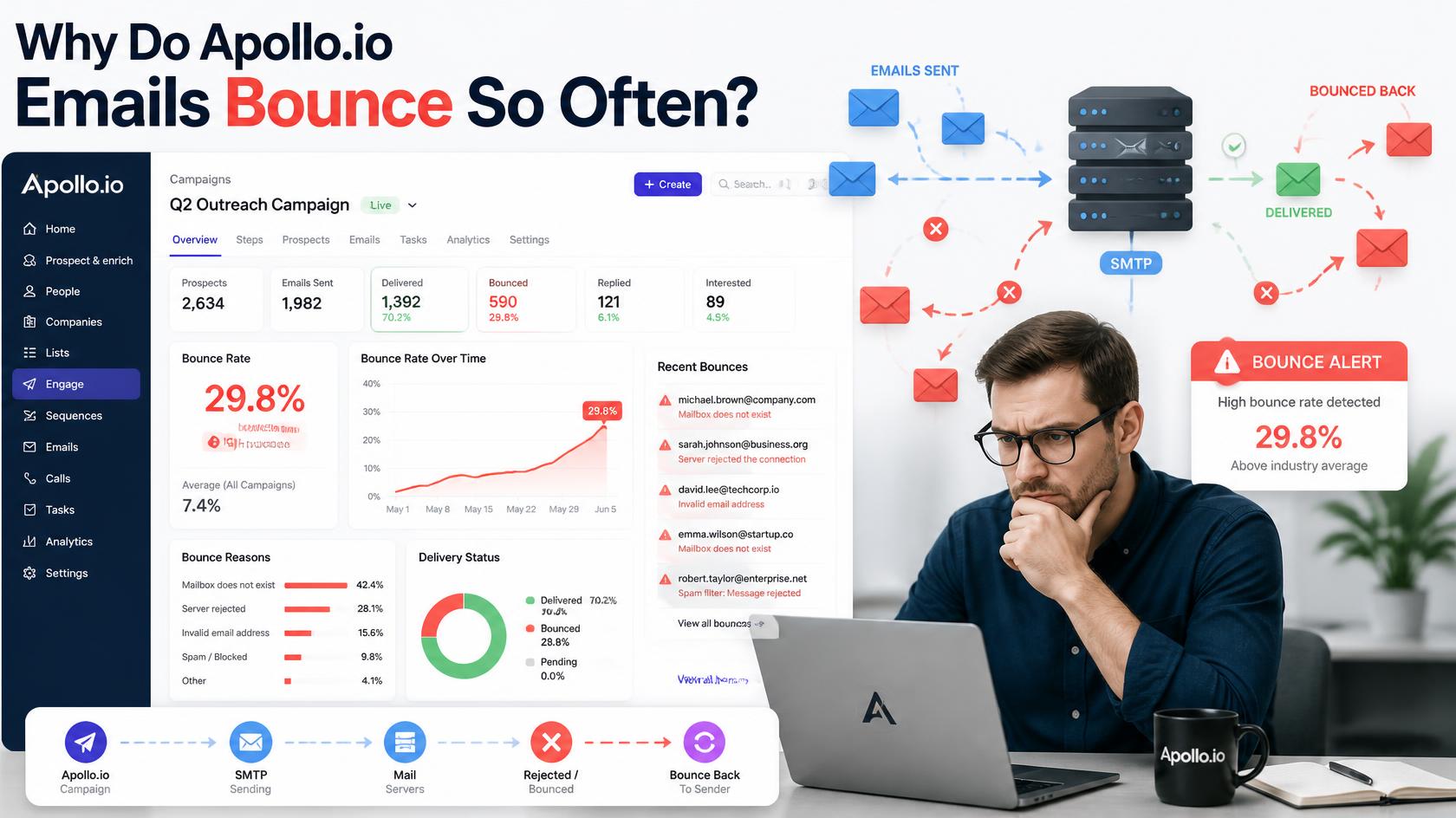
Quick answer: Apollo self-reports roughly 91% email accuracy overall, but that number isn’t uniform across every contact. Accuracy is noticeably stronger on large, well-known company domains and drops meaningfully on small businesses, non-US contacts, and catch-all domains, where Apollo itself often labels the result “guessed” rather than “verified.” The bounces you’re seeing are concentrated almost entirely in that second group, not spread evenly across your list.
Why this feels worse than it did in a demo or a sales pitch
An overall accuracy claim tends to be the headline number, understandably, since it’s the most favorable single figure a company can put on a pricing page. In practice, the specific list you export depends entirely on which companies you’re targeting that day, and a target list weighted toward smaller companies or a specific vertical known for smaller businesses will naturally underperform a generic, blended average built across Apollo’s entire customer base. This isn’t unique to Apollo, it’s true of any tool reporting one overall number across a hugely varied underlying dataset.
What Apollo’s accuracy numbers actually mean
An overall accuracy figure like 91% is an average across Apollo’s entire database, not a guarantee that applies equally to every single contact you pull. Averages like this are pulled up by the easy cases, large, established companies with predictable, well-documented email formats, and pulled down by the hard cases, small businesses, non-US contacts, and companies running catch-all mail servers where confirming a specific mailbox from the outside is technically difficult for any tool, not just Apollo.
How email finders like Apollo actually generate an address
It helps to understand the basic mechanics behind how a tool like Apollo produces an email address in the first place, since it explains exactly where the risk comes from. Apollo maintains a large database built from public sources, professional profiles, company websites, and previously observed email patterns. When you search for a contact at a specific company, it either finds a directly sourced address already in its database, or, if it doesn’t have one, applies that company’s known or assumed email format, like first.last@ or firstinitiallast@, to the person’s name. The first case is genuinely a lookup. The second case is a prediction based on a pattern, and it’s this second case that accounts for most of the bounce risk, since a predicted pattern can simply be wrong for a given individual even when the general company format is right.

The “verified” versus “guessed” label is the key detail
Apollo returns work email addresses with a status label attached: verified, guessed, or unavailable. This distinction matters more than most users realize. A “sourced” or verified pattern has some traceable public origin, a company website, a press release, a professional directory listing. A “guessed” pattern is Apollo predicting an address by applying a known formatting pattern (like first.last@company.com) to a name, without direct evidence that specific address exists. Guessed addresses carry meaningfully higher bounce risk by their very nature, since they’re an educated prediction, not a confirmation.
Why small businesses and catch-all domains are the weak spot
Large, established companies tend to have consistent, well-documented email formatting and clean mail server setups. Smaller companies are far more likely to run catch-all mail configurations, which means the receiving server accepts mail to any address at that domain regardless of whether a real mailbox exists behind it. On a catch-all domain, no tool, Apollo included, can technically confirm a specific mailbox exists from the outside, so results there lean more heavily toward “likely” guesses rather than hard confirmations.
A realistic example
Imagine pulling 1,000 contacts from Apollo for a campaign targeting a mix of enterprise accounts and smaller companies. The 300 or so contacts at large, well-known companies likely perform close to Apollo’s headline accuracy figure, since these domains have predictable formats and clean mail infrastructure. The other 700, spread across smaller businesses, are where the bulk of your bounces are statistically likely to concentrate, since this segment includes most of the catch-all domains and guessed addresses in the batch. Averaged across the whole list, the overall bounce rate can look surprising, until you split it by company size and see the pattern was there all along, just hidden inside a single blended number.
Is Apollo worse than other email finders?
Not dramatically. Independent testing comparing major providers has found Hunter.io testing slightly higher in some comparisons (roughly 90-94% versus Apollo’s 87-91% in one comparative review), while ZoomInfo self-reports a similar 90-95% range. The differences between major providers are generally modest, and all of them face the same fundamental technical limitation with catch-all and small-business domains. Switching finder tools is unlikely to solve this on its own, since the underlying problem, guessed addresses on hard-to-verify domains, applies industry-wide.
What role Apollo’s own verification feature plays in this
Apollo and similar platforms often include some form of built-in email verification alongside their finder features, which can create the impression that a separate check is redundant. In practice, a platform’s built-in check and a dedicated, independent verification service can produce different results, since they may use different underlying methods, different update frequencies, and different thresholds for what counts as “good enough” to pass. Relying on a single check from the same platform that generated the guess in the first place means you never get an independent second opinion on the addresses most likely to be wrong. Running an export through a separate, dedicated verification step adds exactly that independent check.
What this means for how you build target lists in Apollo
If you have any control over how a target list is built, filtering toward larger, more established companies where possible, or at least being aware of the mix you’re pulling, gives you a more realistic expectation before you ever send anything. This doesn’t mean avoiding smaller companies entirely, since they’re often exactly who many B2B products are built for, it means budgeting for a higher bounce rate on that segment specifically and planning your verification step accordingly, rather than being caught off guard when the numbers come in.
What actually fixes this
- Don’t send directly to “guessed” results without an additional check. Treat Apollo’s own confidence label as a signal, not just metadata to ignore.
- Run every exported list through a separate verification check before sending, regardless of what confidence label Apollo attached. This is the single most effective fix, since it catches guessed addresses that turned out wrong before they ever reach your outreach platform.
- Expect a higher bounce risk on SMB and catch-all-heavy target lists, and factor that into your outreach planning rather than being surprised by it after the fact.
- Prioritize verified-status contacts when you have a choice, and treat guessed contacts as a lower-confidence secondary segment rather than mixing them into your primary send.
How to actually diagnose your own Apollo bounce problem
- Segment your last export by company size and compare bounce rates between your enterprise and SMB contacts specifically, rather than looking at one blended average.
- Check what share of your list was labeled “guessed” versus “verified” in Apollo’s own export data, and compare bounce rates between the two groups directly.
- Look for a concentration on specific domains rather than an even spread, since a handful of catch-all-heavy target accounts can disproportionately drag up your overall number.
- Re-run the export through a separate verification check and compare its results against Apollo’s own confidence labels to see how much they agree or disagree.
Does this mean Apollo (or any email finder) isn’t worth using?
No, it means an email finder and an email verifier are two different tools doing two different jobs, and neither replaces the other. A finder’s job is generating a plausible candidate address efficiently, often the only way to reach someone with no other public contact info. A verifier’s job is confirming whether that specific candidate actually works before you spend your sender reputation sending to it. Using a finder without a verifier as a follow-up step is where the bounce problem actually comes from, not a flaw specific to Apollo.

Frequently asked questions
What does “verified” versus “guessed” mean in Apollo results?
Verified means the address has some traceable public confirmation. Guessed means Apollo predicted it by applying a known naming pattern to a company’s email format, without direct evidence that specific address exists. Guessed addresses bounce more often.
Is Apollo less accurate for small companies?
Yes. Accuracy is strongest on large, established companies with predictable email formats, and drops for SMBs, non-US contacts, and domains running catch-all mail configurations.
Should you verify Apollo emails before sending to them?
Yes, this is the single most effective way to reduce bounces from Apollo-sourced lists, regardless of what confidence label a specific address carries.
How does Apollo actually generate an email address for a contact?
Either by finding a directly sourced address already in its database from public information, or by predicting one using a company’s known email formatting pattern applied to the person’s name. The second case, a pattern-based guess, carries meaningfully more bounce risk.
Is Apollo worse than other email finder tools?
Not dramatically. Comparative testing shows modest differences between major providers like Hunter and ZoomInfo, and all of them share the same core limitation on catch-all and small-business domains.
Why does my Apollo bounce rate look worse for small companies?
Smaller companies are more likely to run catch-all mail configurations and less likely to have predictable, well-documented email formats, both of which make it harder for any finder tool to confirm a specific address with confidence.
Should you stop using Apollo if your bounce rate is high?
Not necessarily. Switching finder tools is unlikely to fix a problem that’s structural to how email finders work in general. Adding a separate verification step before sending usually addresses it more directly than switching providers.
Where to start
Export your Apollo list and run it through a proper verification check before it ever reaches your outreach sequence, especially for anything labeled “guessed.” PureListVerifier catches exactly the addresses most likely to bounce, before they cost you a real send.